Practical guide
Dreams in Another Language: Recording Names, Words and Associations
Keep remembered words or sounds, uncertain language and spelling, understood meaning and later lookup results in separate notes. Includes original cards and explained examples; no fixed symbol interpretation or language-skill claim is required.
The quick answer: record the fragment before translating it
If you remember a dream in another language, write the words or sounds you recall, mark uncertain spelling and language, and keep any later translation in a separate note. You do not need to identify the language or finish the sentence before the entry is useful. “Speech I could not identify” is more accurate than assigning a language because a guess sounds convincing.
Begin with three short lines: what I remember; what I think I understood in the dream; what I understand now. The last two can differ. If you remember understanding a conversation but cannot recall its actual words, record that distinction instead of creating a transcript.
The NINDS overview of sleep says that people may not remember most of their dreams, that daytime events can enter dreams, and that the exact purpose of dreaming is unknown. These are broad observations, not an explanation of a particular language, name or phrase. The worksheet below is our original writing aid; those observations do not validate it as a treatment or language-proficiency test.
Separate spoken words, written words and understood meaning
“I dreamed in Spanish” can describe several different remembered experiences: hearing speech you recognized, seeing writing, speaking yourself, or simply feeling that a conversation was in that language. Describe the experience that you actually recall. You do not have to decide that every sound in the scene belonged to the same language.
| Detail | Useful first note | Keep this distinction visible |
|---|---|---|
| Heard words | Write the fragment and the speaker, if remembered. | Exact wording versus an approximate sound written after waking. |
| Words you spoke | Write what you recall saying and to whom. | A remembered attempt versus a demonstrated waking ability. |
| Writing in the scene | Describe where the writing appeared and which marks you recall. | Seen letters or characters versus spelling inferred from a sound. |
| Understood meaning, no words | Record the meaning you felt you understood, labelled as a paraphrase. | A remembered sense of meaning versus a verbatim quotation. |
| Named person or place | Keep the remembered name fragment and role separate. | A dream name versus an identified real person or location. |
| More than one language | Record each fragment with its own uncertain or known language label. | A recalled switch versus an assumption that the whole dream used one language. |
| No recoverable wording | Write that speech was remembered but the words were not. | No remembered words versus proof that nobody spoke. |
A remembered accent, setting or familiar face can be part of the scene, but none is a substitute for the actual words. “The speaker reminded me of my former teacher” can stay an association. It does not establish that the teacher was present or that the speech used the language they taught.
If you saw writing but cannot reproduce it, describe what you recall: a short line on a sign, perhaps several letters, or an unfamiliar script whose characters you cannot remember. Do not select a font, alphabet or complete phrase merely to make the note look finished.
Keep uncertain language and spelling in the first note
Use ordinary labels rather than a confidence score: “language recognized,” “language guessed,” “language unknown,” “spelling uncertain,” or “meaning not remembered.” Say what the label refers to. You might recognize a language but be unsure of the words, or remember several letters without knowing their language.
| Question | Example wording | What the wording does not establish |
|---|---|---|
| Which language? | I thought it was French in the dream; uncertain after waking. | That the remembered speech was actually grammatical French. |
| What sound? | Approximately “na-va-ri”; spelling chosen after waking. | An attested word, a particular alphabet or an exact pronunciation. |
| What writing? | I recall a sign, but only its first letter clearly. | The complete word or the meaning of the sign. |
| Who spoke? | An unfamiliar person; their identity is not remembered. | That a real person sent or intended a message. |
| What was understood? | I remember feeling that it meant “please wait”; original words unknown. | A verified translation from a remembered source sentence. |
The approximate sound in this table is an invented illustration, not a claimed word in any language. You can write syllables in a way you understand, but label them as your approximation. A spelling that resembles a real word later should remain a candidate, not silently replace the original fragment.
Keep question marks attached to the uncertain component. “A person said a name, perhaps Mara?” preserves uncertainty about the name. Writing a confident full name elsewhere and putting one general “maybe” at the bottom makes that uncertainty harder to follow.
If you remember nothing usable, finish with “Speech recalled; wording not remembered” or “No dream recalled.” The first describes a fragment with a gap; the second describes a lack of dream recall. Neither requires you to search for words until a story appears.
Use a dictionary or translation as a later lookup
If you want to check a candidate word after making the first note, put the check underneath with the date, source and exact candidate you looked up. A dictionary can explain a word you supply. It cannot show that this was the word in your dream, resolve an absent spelling or verify the dream speaker's intended meaning.
| Later step | Useful result to record | Question that remains open |
|---|---|---|
| Check a written candidate | The dictionary entry, relevant sense and any context needed. | Whether this spelling was present in the remembered dream. |
| Translate a recalled fragment | The proposed translation and the limited wording supplied. | Missing words, tone, grammar or the intended complete sentence. |
| Ask someone who knows the language | Their suggestion, the fragment they saw and their uncertainty. | Whether the suggestion recovers the original speech. |
| Receive an AI-generated sentence | The new suggested sentence, clearly labelled as generated. | A generated plausible sentence is not a recovered dream transcript. |
Multiple meanings may be available, and a short fragment may not provide the grammar or surrounding sentence needed to choose among them. You can leave several candidates unresolved. Do not choose the most dramatic meaning because it fits a symbolic story you want to tell.
For names, separate a lexical lookup from identifying a person. Finding a real person, place or brand with a similar name does not establish that the dream referred to it. Avoid contacting someone, investigating their private life or making a relationship decision solely because a dream fragment resembles their name.
If you use an external service, you can supply a neutral fragment rather than a complete personal narrative. Remove identifying details you do not want to share. A private note does not need to contain full names, addresses, workplace details or someone else's sensitive history to preserve the language question.
Add context without claiming a cause, omen or language skill
You may separately note a recent lesson, conversation, song, film, trip or older memory that the fragment brings to mind. Write “reminds me of” or “possible association,” not “this proves what caused the dream.” The NINDS description permits the broad observation that daytime events can enter dreams; it does not identify which experience caused this particular fragment.
Keep the language role distinct from the emotion. You may remember being delighted while speaking and embarrassed after waking when no wording comes back. Label those two feelings separately. They do not need to be averaged into one verdict about the dream.
Dreaming that you spoke fluently does not demonstrate your waking fluency. A remembered performance is not an assessed conversation, comprehension exercise or language examination. If you want to review your language learning, use an actual waking task and the feedback relevant to it, rather than scoring a dream as a breakthrough or failure.
A word in an unfamiliar language also does not establish a supernatural message, a past life, a hidden diagnosis or someone else's intention. You can explore a personal association or a documented cultural interpretation at its appropriate level without treating it as verified information about the world.
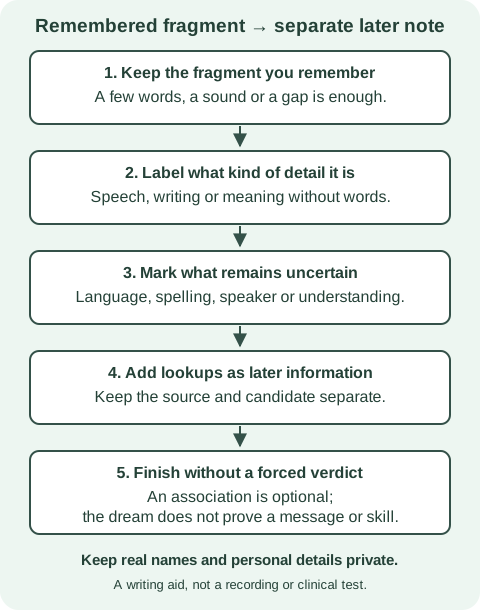
One useful finish might be to revisit a lesson because you enjoy the language, check a real travel detail, or do nothing further. Choose the action from your waking interests and actual information. You do not have to solve a dream before going about your day.
Four fictional notes show the distinctions in practice
These are invented examples, not reports from readers, recordings of sleep or findings from a multilingual-dream study.
1. A short greeting, uncertain spelling
A learner remembers a greeting that sounded familiar but cannot recall its spelling. After waking, they are tempted to write a complete sentence from their textbook.
First note: “A short greeting from a stranger; familiar sound, exact words and spelling not remembered. Dream feeling: pleased. Waking feeling: curious.”
A textbook sentence considered afterward belongs in the later-candidate note, with its source. It cannot supply the missing original wording.
2. Understanding without a remembered sentence
A traveler remembers feeling that someone wanted them to wait, but no actual words come back.
First note: “I felt I understood an instruction to wait. That is my paraphrase; the spoken wording and language are not remembered.”
“Please wait” can describe the remembered sense, provided it is not presented as a verbatim dream quotation or verified translation.
3. A name that resembles something seen later
A writer remembers an uncertain name fragment, approximately “navari.” Later, a search suggests several similar names.
First note: “A person used a name; approximately na-va-ri, spelling chosen after waking. Person and language unknown.”
This string is invented for the example and is not identified as a word in a real language. Similar later results are lookup candidates, not evidence of a real person's involvement.
4. A language switch with unequal recall
A bilingual reader remembers one short phrase in a familiar language and only the impression of another language in the next part of the scene.
First note: “First fragment: wording remembered, language recognized. Second fragment: I thought the language changed, but wording and language identity are uncertain.”
The first clear fragment does not make the second clear. Keep the two entries separate instead of reporting a fully remembered two-language conversation.
Review briefly, and seek help for actual sleep problems
If you revisit the note, compare the specific fields you actually recorded: heard versus written words, recognized versus guessed language, and remembered wording versus understood meaning. “I recorded three uncertain fragments” describes your notes. It is not a measure of all your dreams or proof that a language is taking over your sleep.
A later recollection can be added with its time and uncertainty. A later association or lookup needs its own label. Keep the first entry visible; you can correct a typo without silently replacing an uncertain memory with a confident reconstruction. A missing night is also different from a note saying no dream was recalled.
Keep recording short and optional. This worksheet does not require alarms, deliberate awakenings, a daily streak or staying awake to retrieve a phrase. Stop or shorten the exercise if it becomes upsetting or interferes with sleep.
The NHS guidance on nightmares advises adults to see a GP when regular nightmares affect sleep and everyday life. It also describes a sleep diary including sleep duration, time taken to fall asleep and how you feel the next day. Seek help for that actual effect rather than waiting to decode a word. A language detail alone cannot diagnose the cause, and this worksheet does not determine treatment.
Copy the two records and check six recording choices
Use the first record for the fragment and the second for later information. You can leave a field blank or mark it unknown. Neither sheet is a transcript, language test or requirement to interpret the dream.
DREAM LANGUAGE — FIRST PRIVATE NOTE
Date of waking / time if known or estimated:
Short remembered scene:
Heard speech / seen writing / meaning without remembered words:
Words or approximate sounds actually remembered:
Spelling remembered, or written by me after waking:
Language I thought it was / uncertain / unknown:
Who spoke or where the writing appeared:
Understanding in the dream / understanding after waking:
Dream feeling / waking feeling:
Missing or uncertain details:
No interpretation is required.
DREAM LANGUAGE — SEPARATE LATER ADDITION
Date and time of this addition:
Later recollection / later association / external lookup:
Original fragment being considered:
Candidate spelling, language or translation:
Who or what suggested the candidate:
Source and relevant context, if checked:
What this lookup establishes about the candidate:
What remains unknown about the remembered dream:
Optional waking-life action based on real information:
Keep the first note unchanged; a plausible word is not a recovered transcript.
Download the two cards, three reference tables and six explained cases. Keep the file in a place whose privacy suits the details you choose to record.
Case 1
You remember speech that sounded unfamiliar, but no identifiable words. Should the first note label it as Japanese because the scene looked like a film set in Japan?
Show answer and explanation for case 1
No. Record the speech and scene, and leave the language unidentified.
A remembered setting is different from remembered linguistic evidence. A language suggested by the setting can be a later guess, not a confirmed label for the speech.
Case 2
You felt that an instruction meant “please wait,” but the actual words are missing. Is that English wording a verbatim quotation?
Show answer and explanation for case 2
No. Label it as your paraphrase of the understood meaning.
The remembered sense and the original wording are different fields. A paraphrase can be useful without claiming you remember a source sentence or a verified translation.
Case 3
A friend proposes a real word that resembles your approximate sound. Does that recover the dream word?
Show answer and explanation for case 3
No. Record the suggestion as a later candidate, with its source.
The friend can discuss the fragment you supplied. Similarity and plausibility do not establish what was originally said, how it was spelled or what the speaker intended.
Case 4
In the dream you spoke confidently, but you cannot reproduce the conversation after waking. Does this demonstrate waking fluency?
Show answer and explanation for case 4
No. A recalled dream performance is not a waking proficiency assessment.
Keep the confidence as a remembered feeling. Use a real conversation or appropriate learning task if you want feedback on waking language ability.
Case 5
An uncertain dream name resembles a colleague. Can you treat it as evidence that the colleague is hiding something?
Show answer and explanation for case 5
No. A personal association is not evidence about another person.
Record the name fragment and your later colleague association separately. Any real concern needs real information; the dream does not reveal the colleague's intentions or actions.
Case 6
Regular nightmares are affecting your sleep and daytime life. Should you wait until you identify the foreign words before seeking help?
Show answer and explanation for case 6
No. Seek help for the actual sleep and daytime effects.
The NHS advises adults to see a GP for regular nightmares affecting sleep and everyday life. An unresolved word does not need to be decoded before you discuss those problems.
Sources and further reading
- NINDS: Brain Basics — Understanding SleepGeneral dream recall, daytime context and unknown purpose of dreaming; does not validate this worksheet or explain a specific language fragment.
- NHS: Night terrors and nightmaresSleep diary fields and advice for adults whose regular nightmares affect sleep and everyday life; not a diagnosis from dream language.