Practical guide
Zhougong Dream Books: Titles, Editions and Modern Retellings
Identify the source object before quoting a Zhougong dream interpretation. Follow a verified scholarly record, separate title translations and modern additions, and keep missing edition or passage details explicit.
Start by identifying which object you are reading
“Zhougong dream book” is a search label, not enough information to identify a particular text or edition. Before quoting an interpretation, find the exact title, the kind of object, the edition or manuscript record, and the location of the passage. Keep the historical wording, an English translation and a modern writer’s explanation separate.
You might be looking at a manuscript image, a modern transcription, a scholarly article about a dream book, a translated selection or a webpage reorganized by symbol. Those objects can be related without being interchangeable. A website heading does not tell you which earlier text supplied each sentence.
This guide provides a source card and a worked bibliographic example, not a new collection of forecasts. For comparing a personal association with a research finding, use the dream-dictionary claim comparison. Here the narrower task is establishing what was quoted, from which object, and through which editor or translator.
An incomplete record is still useful. “Modern webpage; original edition not identified” states what you know. Adding a guessed ancient author or folio would make the record less reliable.
Separate the traditional name from a verified author
The Osaka University repository identifies Kunihiro Yuasa’s 1995 article as The Evolution of Books of Oneiromancy: A Study of Xinji Zhougong jiemengshu 新集周公解夢書 Unearthed at Dunhuang 敦煌. The English title is supplied in the repository’s record; Yuasa is the author of that study. That does not make him the author of the historical dream book. [1]
On printed page 1, Yuasa describes 新集周公解夢書 as a dream-divination manuscript attributed to the Duke of Zhou. In that discussion, attribution is part of the work’s historical identity, not proof that the Duke personally composed the surviving wording. Yuasa also interprets “newly collected” as suggesting an expansion and arrangement of an earlier text; that is the scholar’s inference, not an independently checked earlier manuscript in this guide. [2]
新集周公解夢書
Our title translation: “Newly Collected Book of Dream Interpretation of the Duke of Zhou.”
The Chinese quotation here is a title checked in the study, not an omen entry transcribed from a manuscript image. Our English wording is an original title translation, not a quotation from a published English edition. “Newly compiled” is another possible rendering of 新集; a translation choice should not silently become a different original title.
Preserve the exact characters supplied by your source, including a subtitle or final title if present. A simplified-script rendering, romanization and English title help readers search, but label them separately. Do not silently replace the recorded title with the shorter, more familiar 周公解夢.
Give each date a named object
A date is informative only when you say what it dates. The composition of a work, the copying of a manuscript, the printing of an edition, the publication of a study and the release of a digital file are different events. A catalogue may give an estimated period for a copy; record the estimate and the institution’s wording.
| Object | Record these details | Do not infer |
|---|---|---|
| Manuscript | Holding institution, shelfmark, recorded title, copy date or estimate, relevant folio and side. | That the copy date is the date the work was first composed. |
| Printed edition | Editor, publisher, publication year, edition statement, volume and printed page. | That an old work has only one modern edition or identical pagination. |
| Translation | Translator, edition used, publication details and passage location. | That every English sentence is a literal rendering of the historical text. |
| Scholarly study | Study author, journal, year, volume and pages; distinguish quoted material from analysis. | That the study’s author wrote the dream book or that its discussion is the full text. |
| Modern webpage | Page author if supplied, title, URL, checked date and any traceable source chain. | That an upload or update date authenticates an ancient saying. |
Yuasa’s printed page 1 considers the manuscript’s copying period to be Tang. Record that as Yuasa’s 1995 discussion of dating. This guide has not checked a current holding institution’s manuscript description or reconciled later dating research. It therefore does not supply a definitive copy date, shelfmark or composition year. [2]
If two accessible authorities give different dating estimates, retain each estimate with its source and the object it concerns. Check whether one dates the text and the other the surviving copy before declaring a disagreement. If the difference cannot be resolved, say so instead of averaging two centuries into a fictitious precise year.
Work through one real repository record
The following fields come from the Osaka University institutional record and the checked PDF cover and printed page 1. They identify a scholarly article. They are not a substitute for a manuscript catalogue. [1, 2]
| Field | What the accessible record supplies | Scope |
|---|---|---|
| Japanese article title | 夢の書の行方 : 敦煌本『新集周公解夢書』の研究 | Title of Yuasa’s article; includes the work it studies. |
| Author and publisher | Yuasa, Kunihiro / 湯浅, 邦弘; Faculty of Letters, Osaka University. | Creator and publisher of the study. |
| Journal and issue | Machikaneyama ronso. Philosophy / 待兼山論叢. 哲学篇, volume 29. | Journal location, not a dream-book chapter number. |
| Publication date and extent | December 1995; printed pages 1–15. | Date and extent of the article. |
| File availability date | The repository lists 2012.09.22 as the file’s availability start. | Online availability; not the article’s original publication year. |
| Stable identifier | https://hdl.handle.net/11094/6009 | Persistent identifier for this repository item. |
| PDF navigation | Cover is PDF page 1; printed page 1 is PDF page 2. | Record printed and viewer page numbers separately. |
A compact citation can therefore say: Kunihiro Yuasa, “夢の書の行方 : 敦煌本『新集周公解夢書』の研究,” Machikaneyama ronso. Philosophy 29 (December 1995), 1–15, Osaka University repository. For the title and attribution discussed here, specify printed page 1, PDF page 2.
The item is marked open access and Version of Record in the repository. Those labels describe access and the article’s version. They do not validate divination claims, supply a historical author’s signature or show that this guide read every page. We checked the cover and selected printed pages 1, 4 and 5, with visual checks because the automatic extraction misread some characters. The rest of the article and original manuscript images are not represented as fully reviewed.
Trace a passage through quotation, translation and explanation
For an actual interpretation entry, use four layers. First identify the source object and passage location. Second preserve the short historical wording as transcribed by the source you checked. Third label the English translation and who produced it. Fourth put a modern explanation in its own field.
If you read a quotation in a study, write “quoted or transcribed by this scholar,” unless you have also checked the original image. A printed page in the study locates the later quotation; it does not automatically locate a folio in the manuscript. Conversely, a photograph of a manuscript without a readable line location cannot establish which entry a modern website translated.
When a character is unclear, preserve the uncertainty or refer to the editor’s apparatus. Do not guess from the modern English prediction and then use the guessed character to authenticate that prediction. OCR is a search aid; an extracted string is not a checked transcription. Here, extraction of Yuasa’s PDF visibly confused characters in titles and names, so the short quoted title was checked against the page image and repository record.
Quotation marks should contain wording you can trace. If you summarize, label it a paraphrase. If your own explanation introduces “career,” “romance” or another contemporary theme absent from the checked words, label that addition instead of presenting it as a translated ancient sentence.
You can publish a careful account of a historical belief while leaving its predictive accuracy unsupported. Bibliographic verification establishes a textual source. It does not establish that a dream predicts illness, pregnancy, death, wealth or another person’s intentions.
Compare chapter structure without inventing a complete text
Printed page 5 of Yuasa’s study describes a 23-chapter structure, grouping chapters by dreamed objects, relations to days or times, and material concerning bad dreams. This is a specific description in that study. It is not a claim that every webpage called “Zhougong dream interpretation” has 23 sections or identical entries. [2]
A modern symbol index may rearrange older material, omit introductory sections, combine several texts or add new examples. A different section count can alert you to a source question; it does not alone prove that either object is fake. Check the stated edition, included sections, ordering and editorial choices.
Do not build a “complete original” by combining whatever entries are missing from several websites. Repeated text needs a traceable source; missing material remains missing. A proper comparison records which witness or edition supplies each passage and marks differences, omissions and additions.
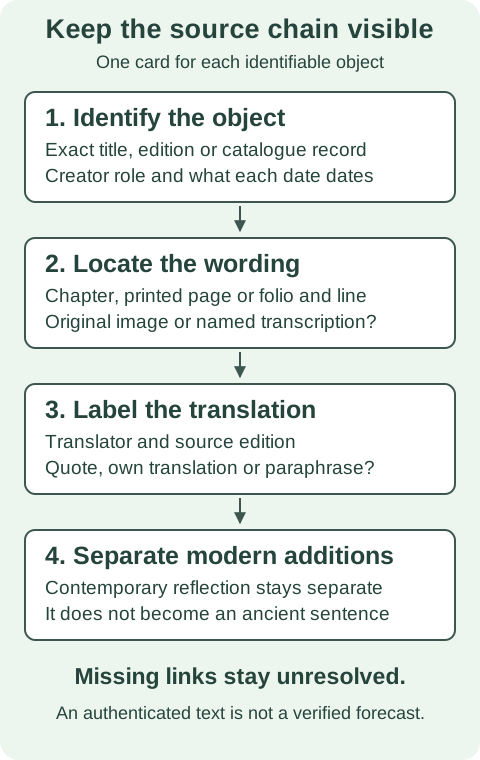
For a small reading project, compare one short entry in two identifiable editions rather than trying to authenticate an entire online dictionary at once. If neither edition is identified, your useful result is a documented source gap, not a reconstructed ancient text.
Keep a source card with explicit unknowns
Copy this card for each source object. Keep a modern webpage card separate from the manuscript or printed edition it claims to use. A stable URL and checked date let another reader revisit the object; they do not replace a passage location.
DREAM-BOOK SOURCE CARD
Question or short claim being checked:
Title exactly as printed, in its original script:
Alternative title: printed / catalogue-supplied / my translation:
Object type: manuscript / printed edition / scholarly study / modern webpage:
Institution and shelfmark, or publisher and edition details:
Stable record URL; checked date:
Date and what it dates: work / copy / edition / study / online availability:
Named creator and role: attributed figure / author / editor / translator:
Passage location: chapter + printed page / folio + side + line:
PDF or viewer page, separately:
Short quotation exactly as checked; unclear characters marked:
Transcription source: original image / named editor / later quotation:
English wording: named translation / my translation / paraphrase:
Modern explanation, in a separate field:
What I have actually opened and read:
What remains unverified:
Do not fill a missing shelfmark, date or line number by guessing.
Download the source card, verified repository example and seven explained checks (TXT). The file contains original reading materials, not a transcription of the complete historical dream book.
For a modern retelling, add a short note such as “author’s contemporary reflection; no historical quotation claimed.” For an unattributed saying, write “original source not supplied.” Those labels allow discussion without inventing a pedigree.
Try seven edition and quotation checks
These cases apply the method to the verified repository record and clearly identified hypothetical situations. They provide decisions and reasons, not a score that measures an edition’s authenticity.
Case 1
The repository lists the article in December 1995 and file availability in September 2012. Which is the article’s publication date?
Show answer and explanation for case 1
December 1995.
The two dates describe different events: publication of the study and availability of its repository file.
Case 2
Yuasa is named as the author in the record. Can the card call him the author of 新集周公解夢書?
Show answer and explanation for case 2
No. Name him as the author of the study about that work.
The creator role belongs to the object described by the record, not automatically to a historical work mentioned in its title.
Case 3
You read our English title below 新集周公解夢書. Is it an authenticated English quotation of an omen entry?
Show answer and explanation for case 3
No. It is our translation of the title checked in the study.
A title translation is neither an entry from the dream book nor a quotation from a named published English translation.
Case 4
A hypothetical webpage gives a dream meaning and says “Zhougong,” without an edition or passage. What goes in the source card?
Show answer and explanation for case 4
Modern webpage; historical edition and passage not supplied.
Record its actual wording and attribution without inventing a manuscript shelfmark, date or ancient original.
Case 5
One hypothetical online list has 27 headings. Yuasa describes 23 chapters. Is that count alone proof that the list is a forgery?
Show answer and explanation for case 5
No. First check the source and how the list was arranged.
Reorganization, omissions or additions can change counts. Unidentified source relationships stay unresolved; do not merge the lists into a supposed original.
Case 6
The PDF viewer shows page 2, while the printed page says 1. How should the attribution passage be located?
Show answer and explanation for case 6
Printed page 1, PDF page 2.
Both locators help readers find it. The viewer’s extra cover explains the offset and is not a new printed page number.
Case 7
A genuine historical entry contains a forecast. Does authenticating its wording establish the forecast’s accuracy for a reader?
Show answer and explanation for case 7
No. Textual provenance and predictive accuracy require different evidence.
You can document the historical belief without treating it as a diagnosis, a future event or information about another person.
Finish with a citation or a documented gap
A useful result is specific: “I checked this title in Yuasa’s printed page 1; my English wording is a title translation; the underlying manuscript image and a current shelfmark remain unverified.” That is stronger than an unqualified “Zhougong says,” because another reader can see where the claim starts and stops.
For an interpretation passage, finish with the identifiable edition, exact location, short quotation and translation label. If the source is unavailable, describe only the modern wording you actually read. You can leave its proposed origin unresolved and return later if a catalogue, scholarly edition or readable image becomes available.
If your purpose is personal reflection, keep that separate too. Use the dream journal for your remembered scene and associations. A dream is not evidence about another person’s behaviour, and reading a historical entry is not a prerequisite for addressing a real sleep or health concern.
Sources and further reading
- Osaka University repository: Yuasa’s 1995 dream-book studyComplete accessible record: study title, author, publisher, journal, date, pages, persistent identifier and file availability; not a manuscript catalogue.
- Kunihiro Yuasa (1995): The Evolution of Books of Oneiromancy (PDF)Selected cover and printed pages 1, 4 and 5 only; title and traditional attribution, scholarly dating inference and chapter structure. Visual checking of extraction errors; no whole-study or original manuscript review claimed.