Practical guide
Zhuangzi’s Great Dream and Great Awakening: Reading the Dialogue
The great-dream words belong to a dialogue that includes its own speaker in the dream. Follow the banquet, interpretation and awakening sequence, then compare it with the separate butterfly ending.
Find Chang Wu Tzŭ’s reply before quoting
In Herbert A. Giles’s 1889 Chuang Tzŭ, Chapter II, the “great dream” sentence occurs inside Chang Wu Tzŭ’s reply to Chü Ch’iao. It is not the narrator reporting a witnessed lecture by Confucius. Confucius is mentioned within the conversation, and later placed inside its dream comparison.
The passage starts with a question about a saying attributed to Confucius. Chang Wu Tzŭ challenges the questioner’s haste: seeing an egg is not already hearing a cock crow. His reply then changes perspectives on life, death and what people believe they know. That setting matters when an isolated quotation sounds like a simple announcement of settled truth.
Use the chapter title, The Identity of Contraries, and the speech containing the banquet-and-sorrow paragraph as your locator. “Zhuangzi says” can name the work informally; a precise reading note should also identify the voice within it. The checked source here is Giles’s English transcription, not a collation of Chinese editions.
Follow the changes between dreaming and waking
The paragraph opens with people dreaming of a banquet and waking to sorrow, then people dreaming of sorrow and waking to join the hunt. These contrasting scenes show that the feeling or apparent situation in a dream need not be the waking situation. The passage then says dreamers do not know they are dreaming.
On a small screen, swipe within this table, or focus it and use the arrow keys.
| Moment | What Giles’s speech describes | Reading question |
|---|---|---|
| Dream scene | Banquet or lamentation | Does the dream’s situation settle the waking situation? |
| During the dream | Not knowing it is a dream; even interpreting it | Is an explanation already outside its frame? |
| Ordinary waking | Recognizing a past experience as a dream | What changed in the viewpoint? |
| Great Awakening | Finding life to be a great dream | Can the present speaker claim an exempt position? |
The text gives neither a timetable for an awakening nor a method for making one happen. Its sequence lets the speech ask whether confident present judgment might itself occupy a limited frame. Treat the capitalized English “Great Awakening” as Giles’s wording in this edition.
An explanation can remain inside the dream
“Some will even interpret the very dream they are dreaming”
This short quotation belongs to the same speech as the Great Awakening. The example is striking because interpretation usually sounds like the step that resolves uncertainty. Here, the interpreter may still inhabit the experience being interpreted. Giving an account does not, within this comparison, establish that one has stepped outside it.
The speech then includes its own speaker: “I who say you are dreams,—I am but a dream myself.” It calls the situation a paradox. A summary that makes the speaker an unquestioned observer above everyone else loses that self-inclusion. Likewise, “the world is fake” replaces a layered question with a conclusion the reader has supplied.
The final reference to a sage explaining it after ten thousand generations extends the difficulty. It supplies no calendar date or measurable forecast. Keep it with the passage’s declared paradox instead of calculating a promised awakening year.
Compare two dream passages without merging their scenes
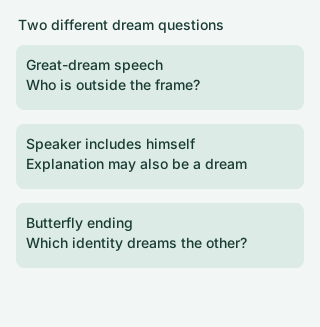
The butterfly ending comes later, after further discussion of argument and the shadow dialogue. Its narrator describes becoming a butterfly in a dream, waking as a man and questioning which identity dreams the other. The great-dream speech does not narrate that butterfly scene. Its focus is the frame from which a person interprets or claims to be awake.
They are useful comparison points because both complicate an easy move from waking to certainty. That is a reading comparison, not proof that they make exactly the same argument. The butterfly version guide examines the distinct ending and Giles’s notes. For the ensuing victory-and-judges sequence, use the separate disagreement guide; it answers a different question.
Write one note that keeps quotation and reading separate
This is an invented reading exercise, not a recovered classroom conversation. A note begins: “Confucius announces that only he is awake and everyone else is dreaming.” Checking Giles’s paragraph changes two parts: the sentence belongs to Chang Wu Tzŭ’s reply, and the reply includes its own speaker in the dream.
A more accurate note is: “In Giles Chapter II, Chang Wu Tzŭ’s reply moves from dream interpretation to a Great Awakening and includes its speaker in the dream. I read this as questioning the standpoint of confident explanation.” The first sentence reports textual features; the second labels the reader’s interpretation.
For a citation, name Herbert A. Giles, translator, Chuang Tzŭ: Mystic, Moralist, and Social Reformer (London: Bernard Quaritch, 1889), Chapter II, banquet-and-sorrow paragraph within Chang Wu Tzŭ’s reply. Add the linked digital transcription and your check date. Do not turn the chapter’s starting page in the contents into the paragraph’s page number.
Three checks before using the quotation
These fictional notes test the passage’s wording and structure.
Case 1
A note says the dream interpreter must already be awake. What does the paragraph add?
Show answer and explanation for case 1
Interpretation can occur within the dream.
Giles explicitly describes interpreting the very dream being dreamed. The interpretation is not presented as proof of an outside standpoint.
Case 2
A note says Chang Wu Tzŭ alone stands outside the great dream. What needs correction?
Show answer and explanation for case 2
The speaker includes himself in it.
The sentence says “I who say you are dreams,—I am but a dream myself.” Preserve this self-including turn.
Case 3
Can the great-dream paragraph be cited as the butterfly narrative?
Show answer and explanation for case 3
Keep the passages separate.
The speech uses banquet, sorrow and awakening; the later ending narrates butterfly identity and waking. Compare them while retaining each scene and voice.
Sources and further reading
- Herbert A. Giles (1889), The Identity of ContrariesSelected ending of Chapter II: Chang Wu Tzŭ’s reply, banquet-and-sorrow dream paragraph, intervening argument and shadow dialogue, and butterfly ending. English text and displayed comments checked; not the whole chapter or a Chinese collation.
- Giles: 1889 title, contents and translation copyright noticeTitle page identifies Herbert A. Giles, London: Bernard Quaritch, 1889. The notice distinguishes the ancient work from the English translation’s copyright status.