Classical story reading
Hua-tzu’s Restored Memory in Liezi: Why He Rejects the “Cure”
Choose another classical story or quotation
Hua-tzu’s family wants his memory restored. When it returns, he describes old emotions as an invasion of his peace and rejects what the family regards as a cure. This is a waking literary story in the “Dreams” selection.
A family’s desired result is not the whole story
In Giles’s Book III selection, Hua-tzu has profound difficulties remembering what he has received, given or just done. The narrator describes his family’s frustration and repeated attempts to obtain help. They want the lost memory restored, and offer a learned professor half their estate if he succeeds.
The episode initially presents that result as desirable from the family’s standpoint. Its surprise comes afterwards: memory returns, but Hua-tzu does not experience the change as an uncomplicated benefit. His final speech makes him another evaluator of what has happened, rather than simply the object of everyone else’s assessment.
This is a named literary episode, not a clinical case whose diagnosis, causes and outcome have been independently verified. Calling it a story about conflicting valuations of memory preserves what can be read directly. Calling it evidence that forgetfulness is healthier would add a conclusion neither the source type nor the narrative can support.
Swipe within the table on a small screen, or focus it and use the arrow keys.
| Voice or event | What is sought or reported | Question the ending raises |
|---|---|---|
| Family | A return of memory; substantial payment is offered | Is their desired result identical to his experience? |
| Professor | Promises a remedy and then keeps the procedure secret | What evidence of a replicable method is actually supplied? |
| Narrated recovery | The long-standing difficulty is said to disappear | What changes besides the ability to remember? |
| Hua-tzu’s final speech | Loss, joy, sorrow, love and hate return as turmoil | Why does he reject the result the family wanted? |
What the seven days do not tell a reader
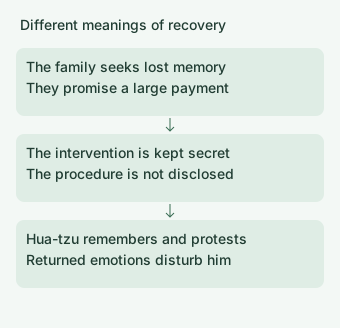
Before the professor appears, the narration says divination, exorcism and physicians’ remedies have failed. His promise distinguishes his approach from those attempts. He then insists that the methods are a family secret and that attendants must stay away while he is shut up with Hua-tzu.
The text describes preliminary deprivation and coercion, followed by seven days behind a closed door. It does not reveal what happens during those seven days. That gap is part of the account: a reader cannot recover a complete treatment protocol from an undisclosed procedure.
For literary analysis, the professor’s secrecy helps concentrate attention on the reported outcome and Hua-tzu’s response to it. It supplies neither a safe intervention nor evidence of efficacy. Recasting the scene as instructions would change its purpose while concealing the very information the narrative withholds.
Why restored memory makes Hua-tzu angry
After the reported restoration, Hua-tzu drives his wife away, strikes his sons and pursues the professor with a spear. When stopped and asked why, he contrasts his former unawareness of the outer world with the sudden return of events from half a lifetime.
His explanation lists preservation and destruction, gain and loss, sorrow and joy, love and hate. These are not merely recovered facts. They are emotionally charged relations to what has happened. He depicts them as invading his peace and fears their continued disturbance.
That distinction makes the speech more precise than “he prefers not to remember.” His objection concerns the returning burden of attachment and evaluation. The story lets the reader ask what is being restored when memory returns, and why different people can judge the same change differently.
The violence does not become justified because the final speech is philosophically interesting. Likewise, giving him a voice does not establish that the family’s concerns are worthless. A useful interpretation identifies the conflict without turning either character’s perspective into a universal rule.
Why a waking memory story appears beside dreams
The narrator does not say Hua-tzu is dreaming during this episode. It is included in the English Book III “Dreams” selection, but its central issue is memory and the valuation of experience. A chapter heading alone should not convert every event underneath it into a dream.
The displayed ninth note compares his condition with the Highest Principle and the Absolute. That is commentary in the edition, not Hua-tzu diagnosing himself or a present scientific explanation. Keep the narrated speech and the note distinguishable when citing them.
For a concise citation, identify Lionel Giles, Taoist Teachings from the Book of Lieh-Tzŭ (1912), Book III, the Hua-tzu episode beginning with his loss of memory. Mention note 9 separately if using its interpretation. The introduction warns through its selection conventions that this English arrangement should not be treated as a complete Chinese witness.
Compare the traveller’s response to a falsely named homeland. That other waking story also makes meaning and emotion depend on how experience is presented. Neither needs an invented sleeping scene to become relevant to a discussion of dream and waking.
Three checks on the reported recovery
These invented reading notes examine the literary account, not a patient’s needs.
Case 1
A note says the family and Hua-tzu agree on what counts as recovery. What changes after memory returns?
Show answer and explanation for case 1
Hua-tzu rejects the result and describes it as disturbing.
The family seeks restored memory; his final speech emphasizes the emotionally charged past that returns with it.
Case 2
Can the seven-day method be reconstructed as a tutorial from this episode?
Show answer and explanation for case 2
No. The procedure is expressly kept secret.
The narrative reports isolation and an outcome without disclosing the intervention, and supplies no independently verified clinical evidence.
Case 3
A heading labels this “Hua-tzu’s dream of losing memory.” Is that what the narrator says?
Show answer and explanation for case 3
No dream is narrated in this episode.
It is a waking memory story placed in the English Dreams selection. The chapter heading is not evidence that he is asleep.
Sources and further reading
- Lionel Giles (1912), Book III: DreamsComplete Hua-tzu episode and displayed note 9; no clinical inference. This guide explains the identified English selection; it does not collate original Chinese witnesses or treat narrated events as verified history.
- Giles’s introduction: selection and commentary conventionsThe introduction says the work is a selection and identifies a separate commentary layer. Its period judgments about authorship, religion and chronology are not adopted as current scholarly conclusions.
- Taoist Teachings from the Book of Lieh-Tzŭ: contents and editionThe source identifies Lionel Giles and 1912; the displayed contents are for this English selection, not proof that the full Chinese work has the same divisions.