Classical story reading
Liezi’s Return to Yan: Why a False Homeland Moves the Traveller
Choose another classical story or quotation
The traveller reacts strongly when a companion falsely labels sites as his homeland. After learning it was a hoax, he reaches the real places but responds less intensely. This ending of the “Dreams” selection happens while awake.
The false homeland is in another state
Giles’s final Book III episode describes a man born in Yen but raised in Ch’u, returning to his native country in old age. On the journey through Chin, a companion presents the surroundings as if they were Yen. The false identification is explicit from the narrator’s standpoint.
The place commonly called Yan in modern discussion appears as “Yen” in this English selection. The guide retains Giles’s other place names when tracing the story, rather than assigning each stopping point a precise modern coordinate. His tenth note offers geographical context for Yen and Ch’u, not a route log.
The important distinction is between where the traveller is and what he has been told about it. He does see a city, shrine, house and mound. What is falsely supplied is their relationship to his own homeland and ancestors. The story does not need fabricated physical objects to show the force of a misleading label.
Swipe within the table on a small screen, or focus it and use the arrow keys.
| Site shown in Chin | Companion’s claim | Traveller’s narrated response |
|---|---|---|
| City | Capital of Yen | He flushes with excitement. |
| Shrine | His own village altar | He sighs deeply. |
| House | His ancestors’ home | Tears well up. |
| Mound | His ancestors’ burial place | He can no longer control his weeping. |
Why the reaction grows as the tour continues
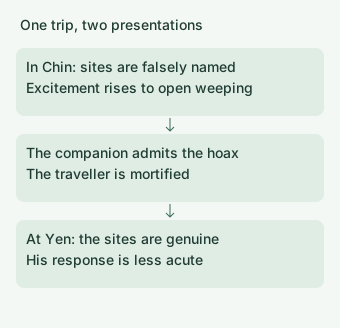
The claims become increasingly personal. The sequence moves from a capital and village altar to the family’s house and burial place. The traveller’s response intensifies along with those claimed connections. A bare summary that he is “fooled by a city” leaves out the progression which makes the scene work.
These responses are narrated emotions, not results measured by a psychological study. The episode lets a reader observe how the traveller responds to the significance he believes each place has. It does not calculate how much of any person’s emotion is caused by information or expectation.
The companion finally laughs and admits that he has been hoaxing him: they are only in Chin. The traveller is mortified. That disclosure changes the setting he thought he was experiencing without undoing the experience he has just had.
The laugh also matters. The deception is not presented as a neutral labelling exercise with the traveller’s informed consent. Its personal cost is visible in his humiliation. A useful literary interpretation need not turn the companion’s practical joke into an ethical recommendation.
Why the genuine sites do not restore the first reaction
At the actual destination, the traveller sees the real city and altars of Yen and the actual abode and tombs of his ancestors. The narrator says his emotion is much less acute. The text confirms the genuine sites; it does not reveal that his ancestry or birthplace was fictional all along.
The difference creates the episode’s question. The same kind of claimed significance no longer produces the same intensity after the hoax. It is reasonable to read the ending as showing that experience and its presentation cannot simply be reset by substituting correct labels for incorrect ones.
That remains a reading, not a demonstrated universal rule. The narrative does not specify whether diminished emotion comes chiefly from shame, disbelief, exhaustion, caution or something else. Naming one of those as the proven psychological cause would fill a gap rather than explain a supplied fact.
A waking story can still question dream and reality
No sleep or dream is narrated in this episode. Its placement at the end of the English “Dreams” selection makes it available for comparison with stories of misidentified experiences, but does not turn it into a dream journey.
Compare the lost-deer dispute. There a woodcutter reclassifies an event after forgetting, and later speakers contest whose dream and whose property are involved. Here the companion supplies false identifications and then openly retracts them. Both concern accounts of experience, but they create different problems and different endings.
For an essay, a precise claim is: “In the final Yen-return episode of Giles’s Book III selection, a false homeland evokes strong feeling, while the real homeland later evokes less.” A further sentence can label your interpretation of the changed response. Neither sentence needs to invent a sleeping traveller.
Use Lionel Giles’s 1912 English selection and the final Book III episode as the locator. The introduction’s selection conventions matter: “Book III” here identifies the checked English arrangement, not a claim that the guide has examined every passage or variant in the original Chinese work.
Three checks on the true and false tour
These fictional reading notes test the narrative’s locations and its ending.
Case 1
A note says the companion invents an imaginary city in a dream. What does the narration actually show?
Show answer and explanation for case 1
Existing sites in Chin are falsely labelled while the traveller is awake.
The false claim concerns their identity and connection to his family, not an explicitly dreamed set of objects.
Case 2
Does the ending establish that the traveller has no real ancestral home?
Show answer and explanation for case 2
No. The narrator confirms the actual sites at Yen.
What changes is his intensity of response after the hoax, not the existence of the homeland.
Case 3
A commentary names one proven psychological cause for the reduced emotion. Is that cause specified?
Show answer and explanation for case 3
No single mechanism is established by the episode.
The changed response is narrated. Shame, caution or fatigue would be further interpretations, not demonstrated explanations.
Sources and further reading
- Lionel Giles (1912), Book III: DreamsComplete final Yen/Chin/Ch’u episode and note 10. This guide explains the identified English selection; it does not collate original Chinese witnesses or treat narrated events as verified history.
- Giles’s introduction: selection and commentary conventionsThe introduction says the work is a selection and identifies a separate commentary layer. Its period judgments about authorship, religion and chronology are not adopted as current scholarly conclusions.
- Taoist Teachings from the Book of Lieh-Tzŭ: contents and editionThe source identifies Lionel Giles and 1912; the displayed contents are for this English selection, not proof that the full Chinese work has the same divisions.