Classical story reading
Lao Ch’eng Learns Illusion: Why the Teacher Says There Is Nothing to Study
Choose another classical story or quotation
Lao Ch’eng seeks magical instruction, but Yin Wen answers by questioning the learner and the object of study: if both are illusions, what exactly is an illusion learning? The pupil’s later abilities are narrated, not taught to the reader.
Why the lesson begins when the pupil asks to leave
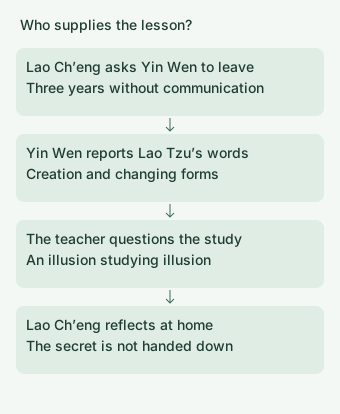
Lao Ch’eng has spent three years with the venerable Yin Wen without receiving communication. He asks permission to go home. The teacher then takes him into an inner room, dismisses the attendants and speaks. The delayed lesson begins by overturning what the learner expects to study.
The scene is not a second version of King Mu’s journey. No visit to a celestial palace is narrated here. Its main action is an exchange about what makes illusion possible, followed by reflection and a claim about the pupil’s subsequent abilities.
In this source, “illusion” is not limited to a stage trick or an optical mistake. The reported speech includes living bodies and the appearance and disappearance of forms. A modern reading that treats the term as nothing more than a magician deceiving spectators would lose the scope of the teacher’s answer.
Swipe within the table on a small screen, or focus it and use the arrow keys.
| Stage | Who acts or speaks | What is supplied |
|---|---|---|
| Three years with the teacher | Lao Ch’eng waits without communication | A problem in his search for instruction. |
| Inner-room conversation | Yin Wen reports words attributed to Lao Tzu | An explanation of creation, change and illusion. |
| Teacher’s challenge | Yin Wen addresses the pupil | The puzzle of an illusion studying illusion. |
| Three months at home | Lao Ch’eng reflects | A narrated change, followed by a secret not transmitted. |
Separate Yin Wen, the reported words and the notes
Yin Wen introduces his lesson as words Lao Tzu addressed to him before a westward journey. That attribution is part of Yin Wen’s speech in the story. It is not an independently authenticated transcript of a historical conversation with Lao Tzu.
The reported account distinguishes the enduring creative process from changes in bodily form. The first is described as profound and inexhaustible; the second is visible, superficial, arising and vanishing. In Giles’s English wording, “Evolution” and “Illusion” name aspects of this distinction. The word “Evolution” here should not silently be substituted for a modern biological theory.
The fourth displayed note identifies the Creative Power with Tao and expands the contrast with a personal God. Some of it is a quoted commentator’s explanation. Those layers can help a reader understand the edition’s presentation, but are not extra lines spoken by the pupil or proof of a modern scientific account of matter.
For an essay, a precise sentence is: “In Giles’s Book III, Yin Wen reports a teaching attributed to Lao Tzu, then questions how an illusion could study illusion.” That preserves the speech chain without overstating how the attribution has been established.
Why calling both people illusions changes the task
The teacher includes both himself and his pupil in illusion. His question is therefore not just “which appearances are false?” It reaches the person seeking the lesson and the person apparently qualified to provide it.
The fifth note develops the difficulty as an illusion studying an illusion. That can be read as a challenge to the learner’s assumption that he stands outside the transformations he wants to command. This is an interpretation of the question, not a proof that learning is impossible or that ordinary responsibilities cease to matter.
Lao Ch’eng then returns home and reflects on the words for three months. The narration assigns him extraordinary abilities afterwards, such as appearing or disappearing and reversing seasonal phenomena. It finishes by saying he never publishes his secret, so it is not handed down.
The time spent reflecting and the subsequent narrated abilities do not form a replicable training plan. Nor does the story state that the reader can obtain those abilities by repeating a sentence for three months. The withheld communication at the beginning and the untransmitted secret at the end help keep mastery from becoming a simple public recipe.
Compare two different uses of a magician
In King Mu’s preceding journey, a magician gives the king experiences which exceed his palace and then overwhelm him; afterwards they discuss what makes one place different from another. Lao Ch’eng instead receives a conceptual challenge to his idea of learning magic.
They can be compared because both complicate easy mastery of appearances. They should not be merged into one biography or treated as proof that one teacher performed both roles. The selection separates the episodes, names different people and gives different endings.
For a citation, use Lionel Giles (1912), Book III, the Lao Ch’eng and Yin Wen episode, with notes 4 and 5 identified when quoted. This guide checks that English selection. It does not claim a complete Chinese textual comparison or establish the historical age of the reported teaching.
Three checks on the lesson’s voices
The following invented notes test attribution and the ending.
Case 1
A note calls the inner-room speech a verified transcript written by Lao Tzu. What is actually presented?
Show answer and explanation for case 1
Yin Wen reports words attributed to Lao Tzu inside a narrative.
The guide can trace the reported voice; that does not independently authenticate a historical exchange.
Case 2
A summary says the teacher alone is real while the pupil is an illusion. What does his reply include?
Show answer and explanation for case 2
Both teacher and pupil are called illusions.
The question reaches the standpoint of the learner and instructor, not only an external object they inspect.
Case 3
Does the ending disclose the pupil’s secret so readers can reproduce it?
Show answer and explanation for case 3
No. The secret is explicitly not published or handed down.
The extraordinary abilities are narrated after reflection; no executable method is transmitted.
Sources and further reading
- Lionel Giles (1912), Book III: DreamsComplete Lao Ch’eng/Yin Wen episode and displayed notes 4–5. This guide explains the identified English selection; it does not collate original Chinese witnesses or treat narrated events as verified history.
- Giles’s introduction: selection and commentary conventionsThe introduction says the work is a selection and identifies a separate commentary layer. Its period judgments about authorship, religion and chronology are not adopted as current scholarly conclusions.
- Taoist Teachings from the Book of Lieh-Tzŭ: contents and editionThe source identifies Lionel Giles and 1912; the displayed contents are for this English selection, not proof that the full Chinese work has the same divisions.