Classical story reading
King Mu and the Magician: A Long Journey in an Unmoved Body
Choose another classical story or quotation
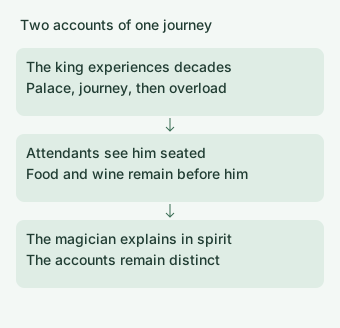
King Mu experiences a magnificent journey that seems to last decades, yet returns to unchanged food and attendants who say he never left his seat. The magician explains the difference as a journey in spirit.
Why the king’s magnificent palace is still not enough
King Mu begins by treating a magician from the far west as an honoured, almost divine guest. When the guest dismisses the royal accommodation, food and companions, the king builds an extravagant pavilion. Giles’s account says its construction empties five treasuries. The episode is already about escalating standards before any dreamlike journey begins.
The new earthly pavilion seems extraordinary until the magician takes the king to his own palace. Its materials, position above clouds and unfamiliar sensations dwarf the king’s building. Looking down, Mu sees his royal residence as scarcely better than a rough heap. The comparison has moved: what seemed lavish from one standpoint now seems crude from another.
This is why the costly building belongs to the argument rather than serving as decorative background. The king tries to satisfy a demand for ever-greater splendour. Each new vantage point can lower the value of what he has already obtained. The story does not identify a final level of luxury that makes the problem disappear.
Separate apparent duration from the attendants’ account
Swipe within the table on a small screen, or focus it and use the arrow keys.
| Account | Evidence inside the narrative | What it does not establish |
|---|---|---|
| King’s experience | His stay seems to last several decades. | A measured duration outside the journey. |
| Return to consciousness | Wine still has sediment; food remains fresh. | An independently recorded clock time. |
| Attendants’ report | They say he has been sitting quietly. | Their observation of his experienced palaces. |
| Magician’s explanation | The two bodies did not move; the journey was in spirit. | A tested mechanism for travelling through time. |
The king’s experience and his attendants’ account answer different questions. One gives the duration as it seemed to him; the other describes what those around his throne saw. The meal supplies a striking narrative sign of continuity. It does not give a stopwatch reading from which to calculate how many years equal one minute.
Retellings sometimes call the entire episode “a dream.” That is reasonable shorthand for its return to consciousness and altered viewpoint, but the magician’s own explanation in this version is more specific: a wandering in spirit while bodies remain in place. Attribute that explanation to its speaker instead of making it a scientific assertion by the guide.
Why the second journey ends in a request to return
There are two stages of travel with the magician. The first reaches a palace that exceeds ordinary sensory experience. In the next region there is neither the familiar sun and moon above nor rivers and seas below. Its light and sound overwhelm the king, and the narration describes his capacities failing. He asks to be taken back.
The magician then pushes him, and Mu experiences falling before finding himself at the throne. Ending the story at the first dazzling palace would erase this reversal. Greater intensity becomes disorientation rather than greater satisfaction. The displayed first note describes the region using the Great Void and the Absolute; that interpretation is separate from the narration of the king’s distress.
He also does not immediately settle the experience. The text describes three months before he is himself again, followed by further inquiry. The later conversation matters: he asks the magician to explain the discontinuity between where he felt he went and where his attendants say he remained.
Read the magician’s reply and the note without conflating them
The magician asks what essential difference there is between the sky-palace and the earthly palace, or between the travelled spaces and the royal park. His reply shifts attention from which place is most splendid to the conditions under which either seems real and desirable. It also speaks of ongoing change and the relativity of fast and slow.
The third displayed note extends the comparison from sky-palace to royal palace to a peasant’s dwelling. It says that pursuing something which satisfies desire once and for all is fruitless. It then reports that the continuing story includes a journey west and that Mu never truly attains Tao. The continuation is described in the note; it is not fully narrated in this selected episode. Cite that distinction rather than pretend the guide has read an unprovided continuation.
Compare the Yellow Emperor’s Huaxu dream for a different royal ending, or Lao Ch’eng’s lesson about illusion for a teacher who challenges the learner’s starting assumptions. The shared motifs do not make the characters, voices or claims interchangeable.
Three checks on the journey’s frame
These fictional reading notes test the story’s actual turns.
Case 1
A diagram gives the trip a measured length of forty years. Is that duration supplied?
Show answer and explanation for case 1
No measured external duration is supplied.
The stay seems like several decades to Mu. The unchanged meal and attendants belong to a contrasting account, not a clock conversion.
Case 2
A summary says the king happily remains in the first palace forever. Which event is missing?
Show answer and explanation for case 2
A second journey overwhelms him and prompts a return.
He requests help in an unfamiliar region and experiences falling before becoming conscious at his throne.
Case 3
A reader says the narrated journey proves that Mu attains Tao. How does the displayed note qualify that?
Show answer and explanation for case 3
The third note says he never truly attains Tao.
Its reference to a further western journey is commentary on a continuation, not proof of successful attainment in the selected scene.
Sources and further reading
- Lionel Giles (1912), Book III: DreamsComplete first Book III episode and displayed notes 1–3. This guide explains the identified English selection; it does not collate original Chinese witnesses or treat narrated events as verified history.
- Giles’s introduction: selection and commentary conventionsThe introduction says the work is a selection and identifies a separate commentary layer. Its period judgments about authorship, religion and chronology are not adopted as current scholarly conclusions.
- Taoist Teachings from the Book of Lieh-Tzŭ: contents and editionThe source identifies Lionel Giles and 1912; the displayed contents are for this English selection, not proof that the full Chinese work has the same divisions.