Classical story reading
Liezi’s Lost Deer: Who Dreamed, Who Found It and Who Gets It?
Choose another classical story or quotation
A woodcutter hides a deer, forgets where it is and decides the event was a dream. Someone else finds it; a later dream brings a quarrel to court, where the deer is present but the accounts remain unsettled.
Begin with what the narrator says happened to the deer
The narrator first describes a man gathering fuel in the Chêng state, chasing and killing a deer, and hiding its carcass in a dry ditch under brushwood. Only afterwards does the man forget the location and become convinced the affair was a dream. In this version, the opening event is not introduced by the narrator as a dream.
That distinction lets the reader see how an account changes. The woodcutter’s later belief does not retroactively replace the way the opening is narrated. He tells the story to people on his way. One listener follows the indications, finds the deer and carries it home.
Swipe within the table on a small screen, or focus it and use the arrow keys.
| Stage | What happens | Whose account changes |
|---|---|---|
| Killing and concealment | The woodcutter hides the carcass in a ditch. | He initially rejoices at obtaining it. |
| Forgotten location | He cannot remember the hiding place. | He comes to regard the event as a dream. |
| Retrieval | A listener follows the indications and finds it. | The finder calls the woodcutter’s dream true. |
| Later dispute | The woodcutter dreams of the place and the taker, then seeks him. | The two claimants quarrel. |
| Court | The deer is present during the judgment. | The magistrate proposes dividing it. |
The table reports the narrative, not a legally verified chain of custody. A physical object and an account of how it was obtained are related, but are not identical kinds of evidence within the story.
Why finding the deer does not end the disagreement
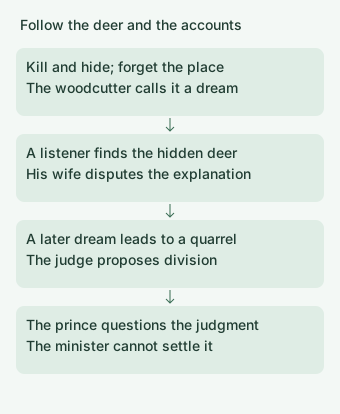
The finder tells his wife that a woodcutter dreamed of obtaining a deer and that finding it makes the dream a true dream. His wife proposes a different possibility: perhaps her husband dreamed the meeting with the woodcutter. She points to the absence of the woodcutter, although the deer is plainly present.
The husband then retreats to what benefits him: he has the deer, so why care whose dream it was? That response is practical, but it does not resolve his wife’s challenge about the story of its origin. The narrative separates possession from explanatory certainty.
The wife’s proposal is also not a revelation delivered by the narrator. She challenges the account her husband brings home. A summary that declares “the wife proves the woodcutter never existed” would give her suggestion a conclusive status it does not have. The woodcutter appears again in the ensuing dispute.
The later dream is a separate event
The woodcutter goes home without being especially disgusted at losing the deer; the displayed seventh note explains that he thought the whole thing was a dream. That night he dreams of the actual hiding place and the man who took the animal. The next morning he follows this dream and confronts the finder.
There are therefore two different uses of “dream” in his sequence. The first is a belief formed after forgetting a waking event. The second is an explicitly narrated night-time dream which directs his next action. Collapsing them into “he dreamed of a deer and it came true” removes the forgotten location, public telling, retrieval and disputed possession.
The story supplies no independent method for deciding whether a contemporary dream reveals a thief or a hidden object. Its later dream operates inside a crafted narrative whose other speakers keep revising what counts as dream or reality. Use it to follow those revisions, rather than to accuse someone on the basis of a dream.
Why the magistrate’s judgment is not the final explanation
The magistrate recounts the conflicting accounts, distinguishes the first killing from the woodcutter’s later dream and notes the wife’s version. He then points to the deer in court and proposes dividing it between the disputants. The action is a way to settle the immediate quarrel without producing one uncontested account.
Even that position is challenged when the case reaches the prince. He says the magistrate must have dreamed the whole affair. The prime minister admits he cannot disentangle dreaming from waking, invokes the absent authority of the Yellow Emperor and Confucius, and recommends upholding the decision.
The ending thus preserves a decision while withholding final explanatory certainty. The minister’s inability and practical recommendation belong together. “Nobody can say anything, so no decision is possible” would omit the recommendation; “the court proves what really happened” would omit the prince’s challenge.
The displayed eighth note interprets the passage as implying no real distinction between dream and waking. That is a separate comment in the edition. The narrated ending has its own specific sequence of speakers and provisional settlement. Keep the commentary labelled when using it in an essay.
Compare the traveller shown a false homeland to see another story in which a confidently supplied label shapes experience. The two are not the same incident: one ends in a court dispute, the other in a changed emotional response.
Three checks on who says what
These fictional notes test the sequence and the authority of each account.
Case 1
A note begins, “The narrator says a woodcutter dreamed of killing a deer.” What should change?
Show answer and explanation for case 1
The narrator first reports killing and hiding; the woodcutter later calls it a dream.
Forgetting the location changes the character’s belief. A separate night-time dream occurs later.
Case 2
Does the wife’s alternative establish that no woodcutter existed?
Show answer and explanation for case 2
No. It is her challenge to the finder’s account.
The narrator subsequently follows the woodcutter and brings him into the dispute; her proposal is not conclusive narration.
Case 3
A summary ends with a court that has solved every uncertainty. Which two final voices are missing?
Show answer and explanation for case 3
The prince questions the judgment, and the minister cannot disentangle the accounts.
The minister still recommends upholding the division. Practical settlement and final certainty remain different.
Sources and further reading
- Lionel Giles (1912), Book III: DreamsComplete woodcutter/deer episode and displayed notes 7–8. This guide explains the identified English selection; it does not collate original Chinese witnesses or treat narrated events as verified history.
- Giles’s introduction: selection and commentary conventionsThe introduction says the work is a selection and identifies a separate commentary layer. Its period judgments about authorship, religion and chronology are not adopted as current scholarly conclusions.
- Taoist Teachings from the Book of Lieh-Tzŭ: contents and editionThe source identifies Lionel Giles and 1912; the displayed contents are for this English selection, not proof that the full Chinese work has the same divisions.