Classical story reading
The Yellow Emperor’s Huaxu Dream: Why the Ruler Stops Trying
Choose another classical story or quotation
The Yellow Emperor’s dream contrasts a strained ruler with a society that goes on without one. His waking insight changes his relation to rule, but the story does not turn it into a technique he can teach.
Why both of the ruler’s first approaches fail
The Yellow Emperor first attends to his own pleasures and physical well-being. He then turns his attention to putting a disordered empire in order. In Lionel Giles’s 1912 English selection, neither approach resolves his distress: both periods end with a haggard or dulled ruler. The dream becomes intelligible when those two failures remain in view.
The first failure does not simply mean that public duty will cure private dissatisfaction. The second fifteen-year period has already tried the opposite priority, with exhaustive application of intelligence and strength. When he finally speaks about his fault, he names excessive attention to himself and excessive regulation of everything. This is the story’s diagnosis of its character’s predicament, not a medical judgment about a reader.
Swipe within the table on a small screen, or focus it and use the arrow keys.
| Phase | The ruler’s approach | The narrated result |
|---|---|---|
| First fifteen years | Protect himself and satisfy the senses | Melancholy, dullness and confusion remain. |
| Next fifteen years | Exhaust effort and wisdom on governing | The strain remains despite intervention. |
| Three-month withdrawal | Abandon schemes and direct intervention | The dream follows a period of attempted release. |
| After the dream | Know a Way he cannot communicate | The narrative describes twenty-eight years of subsequent order. |
These numbers describe the narrated sequence. Adding them up does not date the episode or authenticate the reign. The source here is an identified English literary selection, not a chronology assembled from historical records.
Read Hua-hsu as the dream’s contrast with control
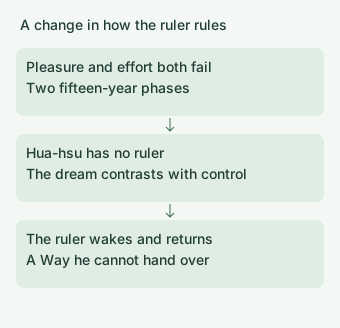
The emperor reaches Hua-hsu in a daytime dream. Giles writes that ordinary transport or walking cannot reach it. The people have no head or ruler, and their society goes on of itself. This is a deliberate contrast with the emperor’s earlier effort to direct everything.
The description extends beyond institutions. Desires, aversions, fear and attachment do not govern the inhabitants in the ordinary way. Then extraordinary images show water and fire failing to harm them and movement through air without obstruction. Those images belong to the narrated ideal; they are not evidence of a community whose citizens could safely ignore physical dangers.
“Huaxu” is a convenient modern romanized label for the place Giles spells “Hua-hsŭ.” This guide follows that English episode rather than proposing a Chinese-character reconstruction or locating the kingdom on a modern map. Nor does “without ruler” by itself supply a contemporary political programme: the story imagines a whole changed relation to desire, life and death, not merely a vacant office.
Why the emperor cannot hand over what he learned
After waking, the emperor tells his three ministers about the dream. He says he had spent three months seeking a way to nourish his own life and regulate others, without finding it. He now claims to know the Perfect Way, yet says he cannot impart it to them.
That final difficulty is easy to lose in a motivational retelling. The insight does not arrive as a set of instructions: visit this place, copy these laws, then obtain the same result. His statement that the Way is not sought through the senses frustrates precisely that kind of handover. The displayed fifth note develops the same problem of communication, but remains a note rather than a further speech by the ministers.
The next paragraph nevertheless describes great orderliness during the following twenty-eight years, nearly equalling the dream kingdom. The emperor returns to a role in the empire; the dream does not end with everyone moving to Hua-hsu. The narrative links changed understanding with subsequent order while leaving the transfer of that understanding unresolved. “He wakes and immediately teaches a successful policy” would change the actual ending.
Keep “fasting in heart” and the notes in their own layer
The withdrawal paragraph uses “fasted in heart.” The displayed second note expressly distinguishes this from abstaining from food or bodily mortification. A retelling that prescribes starvation has therefore not only added a modern application; it has ignored a qualification printed with its own source.
Other notes interpret governing, the soul’s dream journey and communication of the Way. The third note presents a belief about a spiritual component leaving the body. Treat it as a historical explanation in the edition, not a finding demonstrated by this dream. The introduction identifies commentary as a separate layer; it also contains period judgments about the age and character of Taoist writings. None is silently converted here into present scholarly consensus.
For a useful comparison, read King Mu’s journey with the magician. Both narratives involve rulers and extraordinary travel, but their endings differ. Huaxu changes a ruler’s relation to control; the other ruler’s pursuit of ever-finer experiences remains unsatisfied in the displayed note. Comparing endings is more informative than declaring that both emperors simply “escape reality.”
Three checks on a retelling
These invented reading notes test the identified source; they are not historical quotations or recorded classroom responses.
Case 1
A note says the emperor first failed at governing, then solved everything by pursuing luxury. What does the sequence show?
Show answer and explanation for case 1
The two approaches both fail, and pleasure comes first.
The first fifteen years concern his own enjoyment; the next concern intensive governing. Withdrawal and the dream occur after both.
Case 2
A reader proposes a food fast to imitate the emperor. What qualification is printed with the episode?
Show answer and explanation for case 2
The second note excludes actual food abstention and bodily mortification.
It explains fasting in heart in relation to desires. The literary passage is not a documented health or fasting procedure.
Case 3
A summary ends, “He teaches his ministers the secret.” What should replace it?
Show answer and explanation for case 3
He claims to know the Way but says he cannot impart it.
The following orderliness remains part of the narrative, but no transferable set of policy instructions is supplied.
Sources and further reading
- Lionel Giles (1912), Book II: The Yellow EmperorSix complete opening paragraphs and all five referenced notes of Book II. This guide explains the identified English selection; it does not collate original Chinese witnesses or treat narrated events as verified history.
- Giles’s introduction: selection and commentary conventionsThe introduction says the work is a selection and identifies a separate commentary layer. Its period judgments about authorship, religion and chronology are not adopted as current scholarly conclusions.
- Taoist Teachings from the Book of Lieh-Tzŭ: contents and editionThe source identifies Lionel Giles and 1912; the displayed contents are for this English selection, not proof that the full Chinese work has the same divisions.