Classical story reading
Liezi’s Servant Who Dreams He Is a King: The Reversal and Its Ending
Choose another classical story or quotation
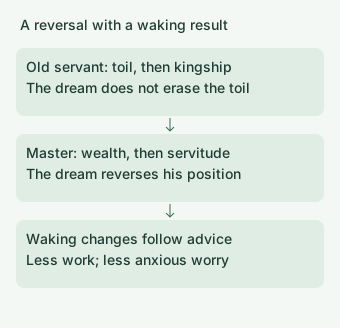
An exhausted servant dreams of being a king while his wealthy master dreams of servitude. The ending changes their waking conditions: the master eases the servant’s toil and his own worry.
Keep the servant’s dream and the master’s dream separate
The story has two dreamers, not one person imagining both sides of a hierarchy. An old servant works on Mr Yin’s estate despite having lost his strength. At night he dreams of kingship, authority and pleasure. Mr Yin enjoys wealth and standing by day, but at night dreams of being another man’s servant, subjected to errands and ill-treatment.
Nothing in Giles’s 1912 English selection says that the two literally change bodies or exchange actual jobs while asleep. The reversal compares their experienced positions. The servant’s imagined authority is especially sharp against his waking lack of control; the master’s imagined subordination is sharp against his waking privilege.
Swipe within the table on a small screen, or focus it and use the arrow keys.
| Character | Waking situation | Night experience | What changes afterwards |
|---|---|---|---|
| Old servant | Hard labour despite exhaustion | Dreamed kingship and freedom to choose | His master lightens his toil. |
| Mr Yin | Property, standing and anxious estate management | Dreamed menial work and abuse | He allows his mental worry to abate. |
Retellings that describe only the happy dream leave out both the master’s opposing dream and the concrete final change. Those omissions turn a story with a social relation into a simple instruction to imagine oneself rich.
Why the servant can speak of happiness without denying misery
Someone sympathizes with the old man’s hard lot. He replies by setting daytime slavery against night-time kingship. His imagined freedom matters to him, and he asks what he has to complain about if both parts of life are included.
But his reply expressly admits his daytime misery. It does not say the labour is easy, that the master treats him fairly, or that dream happiness makes suffering unreal. The narrative has already shown groaning and physical exhaustion. Keeping that admission alongside his reply prevents a quotation about contentment from becoming approval of his treatment.
The servant speaks of a possible hundred-year life divided equally into nights and days. That is a way of weighing two kinds of experience within his argument. It is not a measured account of how long people sleep, an instruction to spend half of life asleep, or a prediction that he will live a hundred years.
A useful reading can therefore hold two facts together: the character finds value in an experience that is not his waking social role, and his waking burden is still a burden. Choosing only one destroys the contrast on which the story depends.
Who supplies the explanation about a balance
The master also ends his days exhausted. His worry is directed at the estate, and his night-time dream repeatedly puts him under another person’s authority. The narration associates his worsening condition with this state and says he consults a friend.
The friend points to his distinguished station and considerable property. To exchange ease for affliction in dreams, the friend says, is a balance in human destiny; the master cannot command pleasant dreams as well as privileged waking moments. This explanation belongs to a character giving advice. It is not a law established by dream research, and the guide does not infer that wealthy people must have unpleasant dreams.
Notice also that the friend does not offer a hidden symbol key. There is no claim that dreaming of a servant forecasts a fall in income. His response compares the master’s demand for advantage in both spheres with the reversal the story has narrated.
The ending matters more than a slogan about being content
After the conversation, Mr Yin does two things: he lightens the servant’s toil and lets his own mental worry lessen. The narration then says his malady decreases. It does not explicitly say that both dreams disappear or that the servant becomes a real king. Supplying either result would complete the story differently.
The reduced workload is an action within the unequal relationship, not merely an internal attitude. An interpretation focused on contentment must account for that action: if the servant’s suffering needed no response at all, why finish with the master easing it? The ending gives the earlier reversal a waking consequence.
This is a literary reading, rather than clinical advice about recurring distressing dreams or workplace guidance derived from an ancient case. There is no independently observed patient, controlled comparison or specified treatment here. That limitation follows from the kind of source, rather than from a warning pasted onto an otherwise medical claim.
For another contrast between experience and the account given of it, compare the woodcutter’s lost-deer dispute. For a ruler whose changing desires drive a different story, read King Mu and the magician. Each comparison keeps its own characters and ending.
Three checks on the reversal
These invented reading questions concern the named literary episode.
Case 1
A summary says the old servant denies that his daily work is miserable. Is that his reply?
Show answer and explanation for case 1
He acknowledges the misery and weighs it against his dream happiness.
The narrative also describes groaning and exhaustion. Dreamed pleasure does not remove those details.
Case 2
A retelling says Mr Yin becomes the old servant in a literal nightly exchange. What does the text supply?
Show answer and explanation for case 2
Two opposed dreams, with no physical exchange stated.
Mr Yin dreams of being another man’s servant; the old man dreams of kingship. The story compares positions.
Case 3
A final note says only the master’s attitude changes. What other change must remain?
Show answer and explanation for case 3
He lightens the servant’s toil.
The ending changes a waking condition in the relationship as well as the master’s worry; dream disappearance is not explicitly reported.
Sources and further reading
- Lionel Giles (1912), Book III: DreamsComplete Mr Yin/old-servant episode in Book III. This guide explains the identified English selection; it does not collate original Chinese witnesses or treat narrated events as verified history.
- Giles’s introduction: selection and commentary conventionsThe introduction says the work is a selection and identifies a separate commentary layer. Its period judgments about authorship, religion and chronology are not adopted as current scholarly conclusions.
- Taoist Teachings from the Book of Lieh-Tzŭ: contents and editionThe source identifies Lionel Giles and 1912; the displayed contents are for this English selection, not proof that the full Chinese work has the same divisions.